1721 - 1796
From the 10
th to the 17
th century,
Russia was ruled by a nobility known as Boyars, until 1462 when the tsars, essentially
emperors, began their reign of power.
Tsar Ivan III, later nicknamed Ivan the Great, was the first in a long
line of tsars to control Russia. Many
historians believe Ivan III’s rule to be the start of the Empire, however it
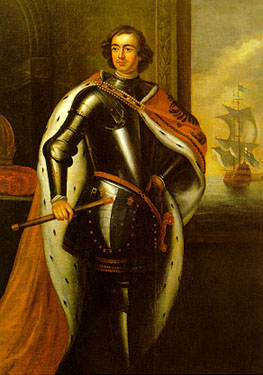
was not officially declared an Empire until Tsar Peter I, known as Peter the Great,
signed the Treaty of Nystad in 1721.
This treaty arose due to Peter’s burning desire to gain control of a harbor in
order to give the Russians access to the sea.
Tsar Peter formed a secret alliance in 1699 with Saxony, the Polish-Lithuanian
Commonwealth, and Denmark against Sweden, which caused the Great Northern War. Sweden finally gave up, Peter got his sea
access, and the Russian Empire was born.
Peter the Great was a very progressive leader. He eliminated the council of nobles that had
been in place for centuries, and replaced them with a nine-member Senate. Peter redrew district lines and split the
countryside into new provinces. He used
his newly organized government to intensify the collection of taxes so much, that tax revenue tripled throughout the Empire during his reign. In 1725 however, just four years after
declaring Imperial Russia an empire, Peter died.
For roughly the next 40 years, the crown was passed along from Peter’s
wife Catherine I, to the empress Anna, to Peter’s daughter Elizabeth, who ruled
for 20 years. Elizabeth played a pivotal
role in the improvements of the arts, sciences, and architecture in the Empire, but did
little for structural reform.
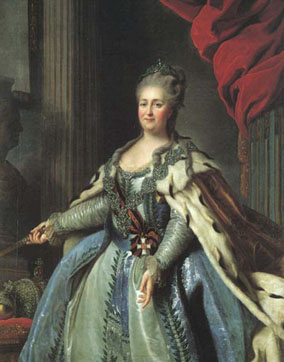
Once Elizabeth passed away, it was the start of the era of Catherine
the Great, who overthrew her unpopular husband and rightful heir to the throne,
Peter III. Catherine II got rid of state
services, brought back the Russian nobility and turned over the majority of provincial
state functions to them. Under Catherine’s
rule, Russia spread its political control over the Polish-Lithuanian
Commonwealth. In 1773, a peasant
uprising in Moscow was quickly suppressed.
The compassion that Catherine the Great implemented into their
punishments gained her much recognition throughout Europe. She increased the power that the nobility
held, which was a pivotal part of her freshly reformed government structure,
while also making claims that the serfs were equal to the nobles.
After a successful war against the Ottoman Empire, Catherine
II expanded the southern border of Imperial Russia all the way to the Black
Sea. She then worked with the rulers of
Prussia and Austria in order to control territories in the Polish-Lithuanian
Commonwealth, which expanded her western border into Central Europe. To uphold a promise made in a treaty with the
Georgians to protect them from the Persians, Catherine II waged another war
against Persia in 1796. Catherine the Great
died later that same year. The
territorial expansion that occurred during her reign had turned the Russian
Empire into a major European power.
- On a side note, below is a graph that depicts the different wars fought by the Empire during the 18th century. This just goes to show how much war was necessary in order to establish and maintain an empire at this point in history.


No comments:
Post a Comment