1796 - 1894
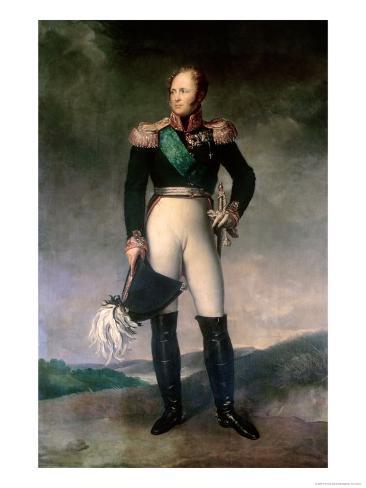
Next in line was Alexander I. Tsar Alexander is best known for defeating Napoleon. After the two had a dispute, Napoleon decided
to invade the Russian Empire, marching his army all the way into Moscow. This ended poorly for the French, as not only
were they decimated on Russian soil, but they were chased all the way back to Paris,
ultimately leading to Napoleon’s demise.
Alexander was labelled the “savior of Europe,” and in 1815 he was placed in
charge of redrawing the map of the entire continent. As much as Europe was booming economically during the Industrial
Revolution, the progress was much less apparent throughout the Russian Empire, due primarily to
their retention of serfdom.
In 1825, Tsar Alexander I was replaced by his younger
brother, Nicholas I, who would rule for 30 years. The well-educated Russian officers in his army, who saw
much of Europe during the Napoleonic Wars, decided that it was time for a
change in Russia, due to their experiences in Western Europe, and led an
uprising at the start of Tsar Nicholas’ reign.
Unfortunately for them, however, this revolt was abruptly squashed, and
led the newly appointed Tsar even further in the opposite political direction they had
hoped for. Government regulations and
censorship increased at a rapid rate in order to prevent future attempts at a
revolution. During his reign, hundreds
of thousands of potential revolutionaries were sent to Siberia. Towards the end of the 1820’s, successful
wars ceded more territory to the Russian Empire, including Dagestan, Georgia, Azerbaijan,
Armenia, Nakhchivan, and several cities in northeastern Anatolia. As the first half of the 19
th century
came to a close, there was somewhat of an internal conflict between those who
wanted Russia to return to the ways of its past, and those who wanted Russia to
become more modernized like Western Europe.
After Nicholas’ death in 1855, Alexander II took over the
throne. Six years later, in 1861,
Alexander II did something that many historians believe to be the most
important event in Russian history during the 19
th century. Rather than waiting around for the inevitable
uprising and revolution of the over 23 million serfs throughout the Empire, Alexander
II decided to abolish serfdom, emancipating all the serfs in Russia. Unfortunately for Alexander II, this did not
effectively silence any talk of revolution. The way in which the lands were divided up and
collectively “owned” by communities, as well as taxes that had to be paid by
the former serfs to the government, which were then distributed to their former
land owners, still left the emancipated serfs at the bottom of the totem pole.
After invading Outer Manchuria from 1858-1860, and selling
Alaska to the United States in 1867, Russia had another conflict with the
Ottoman Empire in the 1870’s. With their
political interests in mind, and acting on the behalf of Bulgaria and Serbia, Russia
went to war with the Ottoman Empire in 1877.
Less than a year later, the Ottoman Empire surrendered as Russian troops
neared Constantinople. However, after
threats from Britain to declare war on Russia, should they have signed the
proposed Treaty of San Stefano, the treaty was never signed. On the plus side though, Alexander II had
aided Serbia, Romania, and Montenegro in the gaining of their independence from
the Ottomans, while simultaneously gaining the provinces of Batumi, Ardahan,
and Kars in the South Caucasus as new territories for Imperial Russia.
Alexander II was assassinated in 1881, passing the throne on
to his son, Alexander III. Alexander III
despised Western Europe, and spent his entire reign reviving the old
traditions. He made extreme efforts to
shut Russia off from Western Europe, and was responsible for a conquest of Central
Asia. He also went after China for more
territory. Alexander III’s structural
reform was essentially his biggest contribution to the Empire, and he was
eventually succeeded by his son, Nicholas II, in 1894.